Monday, October 17, 2011

A Big Booo to Publishers that Don't Allow Sharing of E-Books


How many times have you borrowed a book from a friend?  Loaned a book to a friend?  A friend recommends a book to you, loans you their copy, you read it and return it and usually end up in a discussion about it.  If you loved it, you then recommend it to other people.  If you really loved it, you may go buy a copy because you just have to have it.  And then you may end up loaning it to a friend and so on.


If you buy a paper copy of a book, you have the right to loan away.  And book loaning is good for the publisher (and author and everyone else in the book selling food chain).  Why?  Because word of mouth is what sells books and the circle of loaning spreads the word just about faster than anything.  Book sharing is free advertising of the book and author.


Recently I heard buzz about the book Night Circus by Erin Morgenstern.  It sounded intriguing so I went to my local library web page and put a hold on it.  I was number 97 out of something like 10 copies.  Wow, I'm going to wait a long time.


So I mentioned it to a friend and it turns out that she had just purchased it for her Kindle.  "Cool," I said.  "Could you loan it to me when you're done?"
"Sure," she said.
But she can't.  Why?  Because each publisher can choose to make the electronic version of their book loanable or not.  The publisher of Night Circus chose 'no sharing' (this book is published by Doubleday and sold by Random House Digital).
This burns my biscuits.  My friend paid $12.99 for the Kindle version of this book.  You can get the hardcover version, new, for $9.99!  The Kindle version costs more than a paper version yet it has less value because it can't be loaned or shared.


Authors should be steamed with their publishing houses for this.  Sharing books NEVER hurts sales. Should we do away with libraries in order to bolster sales of print versions of books?  Neil Gaiman has stated his belief that book piracy has  increased his sales.  In this video he talks about how sharing books actually increases sales.


I've moved up to #94 on the wait list for The Night Circus.  One day I'll get to read it . . .


What do you think?  Is there a legitimate reason that publishers won't allow sharing of e-books?
Are there other e-books that you have tried to share but it has been disallowed by the publisher?

Wednesday, September 28, 2011

Drawing Characters can help a Writer Get to Know Them

Writers have various ways to get to 'know' their characters.  For me, I like to do a Q & A with my characters.  I'm like a reporter or talk-show host and I ask them questions and they answer.  This helps me get inside the 'head' of the character.

But when it comes to physical description, I have found it hard at times to physically describe a person (or entity) that doesn't really exist.  Because I'm a visual person, I find that drawing the character can help me get a better handle on physical description, especially for non-human characters.  Here a few that I've done.

For 'Emily's House', a character you'll meet early on is Hindergog.  He's not human though he can speak and he wears clothes.  Early on in the writing of that manuscript, I had to draw Hindergog to get a visual on him.

Hindergog
That's the first drawing I did of Hindergog.  I liked the eyes and the nose is just about right, but I wasn't sure about the fangs.  This is my second drawing, done about a year later.


I liked the ears better in the second one but I still like the eyes best from the first one.  Both helped me to really see Hindergog and I think that helped my description of him.

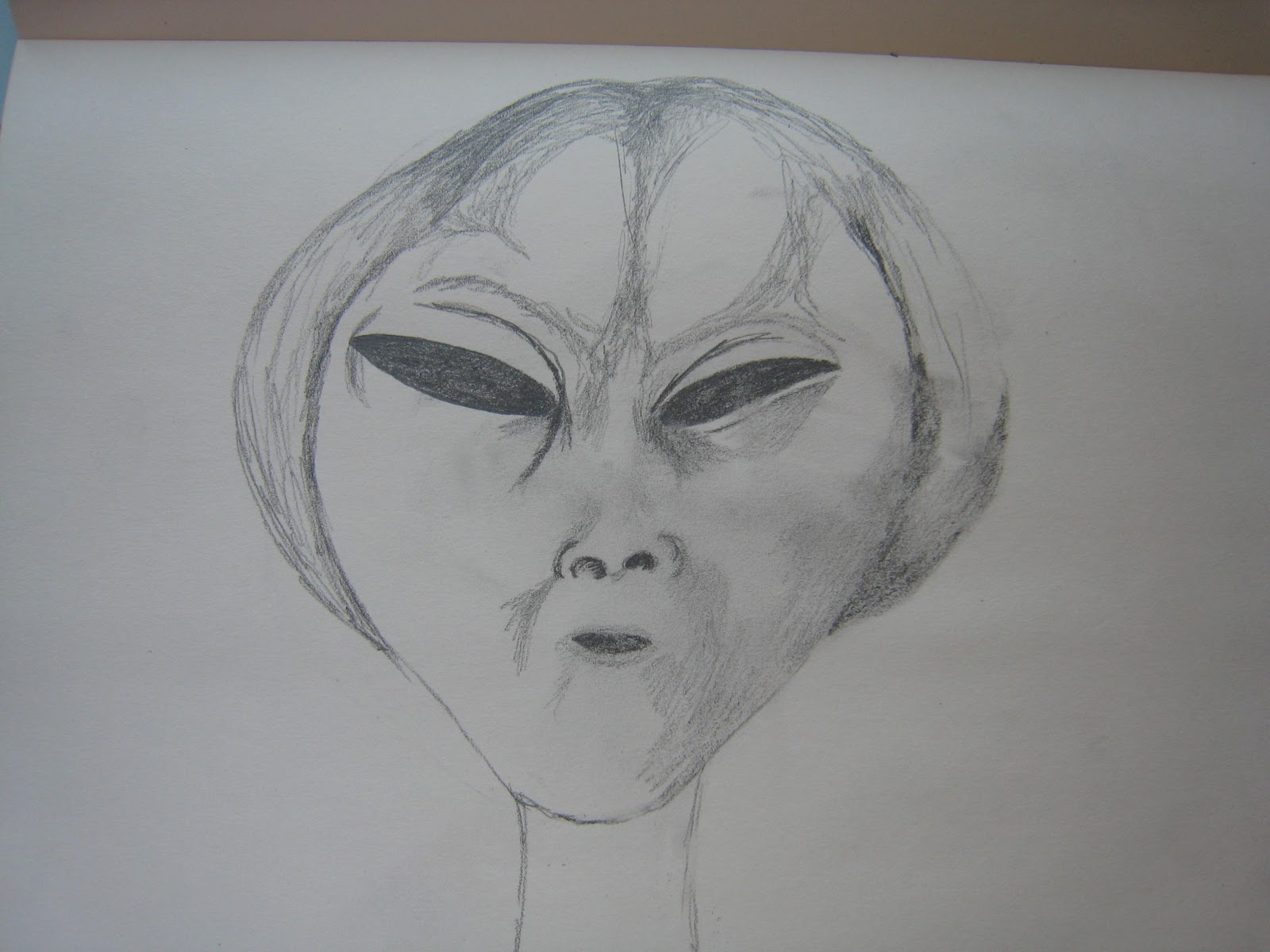
Lately I'm working on the manuscript for 'H.A.L.F.' (which is an acronym for 'Human Alien Life Form').  Because one of the main characters, Tex, is an alien-human hybrid, I wanted to get a handle on what that mash-up looks like.  I started with drawing first a 'grey' alien based on the 'alien autopsy' photos on the internet.

Drawing of a 'Grey'
This isn't great, but you get the idea.  Greys are often depicted with super-bulbous heads (some speculate because they have an extra lobe in their brain).  They are described as having very small mouth openings and small noses.  

What happens when you morph a grey with a young human male?  Here's my rendition:

'Tex', a H.A.L.F.

When I morphed them, the head is human just more bulbous.  He has ears while the alien does not.  His nose is more prominent.  His mouth is still small but slightly larger.  One of the things that came from this exercise is that Tex has a more human chin and jawline, not quite so angular - more square.

But the eyes are the same overly large, dark eyes.  This is a prominent feature of Tex and has impact on the storyline.

Do you find the last one, the drawing of Tex, unnerving?  He's hanging up in my office now on my bulletin board and I have to say, I find him a bit scary!  When I catch a glimpse of him out of the corner of my eye he sort of freaks me out!

If you're a writer, do you ever draw your characters?

Wednesday, September 21, 2011

The Ball is Rolling Now

I can't believe the day is finally here, but I will be sending the Emily's House manuscript off to the book designer and the formatter by the end of the week.  The story is complete - last edits done.  Right now I'm working on those little details like the Acknowledgments page and author bio.

So it has been a long haul from the seed of an idea back in 2007 to the first tentative words plucked out on the word processor in 2008 to a finished manuscript.

What a long strange trip its been!

I pulled the excerpt that I had posted online here because I had changed it so much, the post was irrelevant.  I've decided to put up the prologue only at this time.

In other news, my friend Mark Corneliussen, photographer and video editor, has graciously volunteered to put together the book trailer.  I'm very excited to see how Mark takes my own vision of the story, layered with the musical vision of the story created by my wonderful friend and musician/composer extraordinaire, Jill Robinson of Jill Robinson Music, and adds his own touch to come up with two minutes that sums it up.  I'll post more about that as the project progresses.

Stay tuned.

Wednesday, August 31, 2011

Follow Up to Bullying Post

A friend of mine posted this to her Facebook page today and I thought it was ironic that it showed up on my wall the day after my post "What is Bullying Anyway?" about whether being excluded is bullying.

R2-D2 Does Double Duty as a Hairdryer

Perfect, n'est-ce pa?  Thanks to Michelle Ansley Freno for passing this along.

Less than 25 words and a picture to say it like it is.

Tuesday, August 30, 2011

What is Bullying Anyway?


School districts across the country are struggling with how to stop bullying in the wake of the teens who have committed suicide after being bullied.  My daughter’s school district has undertaken that task and this year sent home information specific to bullying.  They are taking it seriously, as they should, and I applaud the school for adopting a zero tolerance of bullying. 

But the new policy sent home with my third grader made me question:  What is bullying anyway?

For me the classic image of the school bully is the kid that pushes other kids around whether by physical intimidation or verbal threats or insults.  The bully isn’t always the largest kid in the class, but the bully is someone who gets their way through threats, intimidation and fear.

That’s what I thought bullying was.

Here’s what my daughter’s school sent home about bullying:

“Students who name call, exclude others, tease, and/or become physical towards another student will be written up and [the Principal] will review the situation.”  (emphasis added)

It’s that word “exclude” that caught my attention.  At first blush you may say of course, excluding is wrong and can lead to hurt feelings so we should ban it.  But here’s my question:  Are hurt feelings or feelings of being left out the same as bullying?

Please understand that I’m not insensitive to hurt feelings.  I was a geeky nerd kid with red hair – I experienced a lot of hurt feelings in my childhood.  But was it bullying for a particular girl clique that I wanted to be a part of to say “we don’t want to play with you?”

Kids, especially very young children, have virtually no choices in life.  Their parents and their school decide just about everything for them.  Even for teenagers there is a lack of freedom.  Should kids be free to choose who they play with on the playground and who they eat lunch with and who they hang out with?

Or am I being naïve?  With the advent of social media, I know that things have changed for kids and now bullies, especially girl bullies, have the entire Internet and social media web to use for their bullying.  Have things changed so much that we must quash freedom of choice in who we spend our time with in order to protect kids from hurt that can lead to emotional problems and suicide?

Here’s how the Oxford American Dictionary, 2010, defines “bully:”

n. A person who frightens or persecutes weaker people
          v. Frighten or persecute a weaker person

Synonyms are:  persecutor, oppressor, tyrant, tormentor, intimidator, thug

This definition fits with how I’ve always defined a bully.  When you imagine a bully, do these words fit your image?

I’ve been a divorce lawyer and mediator for sixteen years and unfortunately my work has brought me into contact with domestic violence issues.  Domestic abusers are bullies.  Whether the abuser is a man or woman (yes, women sometimes are the abusers though not as often as men), they use their fists or their words (usually both) to intimidate and oppress.  Put downs and insults are the abuser’s daily bread and butter, used to weaken the other person’s self-esteem and resolve.  The physical violence seals the deal so to speak and shows the other person “see, I’m stronger than you and I can get and do what I want.”

It is my belief that bullies are made in their homes where they likely observe bullying behavior by one or both parents.  The bully then hones their craft on the playground, in the lunchroom, and in the corridors of the school.  By the time the bully reaches high school, he or she has likely been bullying since pre-school and knows how to work the system to their favor.  In fact, I can foresee the bully using the “no exclusion” policy to bully someone into playing with them so they can bully them some more!

Bullying is very serious.  My concern is that if we water down and broaden the definition too much it will become meaningless.  Getting your feelings hurt because you didn’t get invited to a party sucks and dealing with mean girls can leave a scar.  But when someone engages in a campaign of constant insults, put downs, threats, and/or verbal or physical intimidation is different.  The latter is bullying. Is the former bullying?

It’s no fun to be excluded by the bitchy, mean, exclusive girls.  But are mean girls automatically bullies?  Is it their exclusion that’s the problem?  Or how they go about it?

Lets get some conversation going about this important topic.  What do you think?

Is excluding bullying?  Has bullying changed?  Do we need to broaden the definition to encompass new forms of bullying?

Have you been bullied in your life?  How do you define bullying?

If you’re still in school, do you agree with the new policies on bullying?  Do you think bullying is a problem and if so, how do we fix it?

Friday, August 12, 2011

Why This Writer Won't Deliver Four to Six e-Books a Year to the Reader

Creating a novel is a long,
winding road
As e-books flourish, self-publishing is exploding and some writers are pumping out a new e-book ever 2-3 months (some even faster).  I’m going to tell you why you’ll probably never see me deliver 4-6 books to the reader in a year.

My brain works on what I call the “Saturate and Distill” method.  Maybe all the beer I drank in college influenced my brain cells to act like a liquor still or maybe I was just "Born this Way."

But for whatever reason, I take in loads of information, then let it tumble around inside my head for a while. When the info is sufficiently distilled, I get inspired and puke up stuff onto the page.  In this stage I’m working fast and furious, trying to get it all down.  I try not to think or second-guess or question myself.  I try to shut my conscious self down and allow all that stuff I learned to mix with my own life experiences, the collective unconscious, my own unconscious self and maybe even what some call divine inspiration.  Mix well and out comes a story.

In the first go round I’m just looking to get a beginning middle and end.  A lot of what happens in this first draft will be cut. Some of it is dialogue that I, the writer, need to hear but you, the reader, would get bored and thrown off track if I leave it in.  Or maybe its just wrong turns the characters take.  That’s cool, the characters need to figure out who they are and what they’re about.  But you, the reader, don’t want to read what sometimes reads back like someone’s diary.

The first draft, the beautiful period of imagination and discovery, is only the beginning.  Some writers have said that the first draft is about figuring out what the book is about.  You write a first draft, put it away for a while, then pull it out and read it through.  And hopefully you have that “Aha” moment when you say, “So that’s what it’s all about!”

Cover art for "Emily's House"
Coming Late Fall, 2011
I have re-worked, revised and re-written “Emily’s House” for a year now!  Granted, it’s my first novel and since I didn’t have much of a clue what I was doing when I started, my editing process was at times a re-write process.
But man, what a difference it makes.  The “Emily’s House” I just turned over to the editor bears little resemblance to the “Emily’s House” it was last August at the end of the first draft phase.

The other reason that I’m not going to promise readers a new book every three months is because my books tend to require a lot of research.  Why?

Because I create new takes on existing mythologies.  In “Emily’s House,” my starting point was pre-Christian Celtic mythology.  But my early research revealed the tantalizing fact that the Celts originated east of modern-day Europe and they were influenced by Vedic traditions out of India.

Add a little Celtic mythology with some Buddhist philosophy, stir in some Vedic thought, and voila!  A new mythology is born, one that feels familiar but is not exactly like anything else.

Screech!  This past week I’m like a car factory re-tooling for a new model.  My brain has to dump faeries and torcs and enchanted wells and particle colliders.  Now I’m streaming “Ancient Aliens” on Netflix and reading about the 1947 crash in Roswell and about alien abductions.  I’m filling up on alien mythology now as my brain sifts and filters and distills it, creating its own alien mythology.

In my current work in progress, “H.A.L.F.”, the main character Erika Holt will meet up with Tex, an alien-human hybrid who is traipsing through the desert trying to escape from the U.S. government facility where he was created.  What starts as Friday night good times in the desert for Erika and her friends, Ian and Kyle, ends up being a nightmare of three teens and a hybrid against the might of the U.S. government.


I’m a huge sci-fi fan and thought I already knew a lot about alien mythology.  I was wrong.  As I began reading articles and books, I realized there was a whole lot more to the alien mythology than I realized.  Then I began watching episode after episode of “Ancient Aliens” streaming on Netflix and I realized that not only must Giorgio Tsoukalos be an alien because there’s no other explanation for how he can get his hair to do that, but that this alien mythology thing is expanding so much, it is in fact replacing Judeo-Christian religion for a lot of people.  Ancient alien theorists have replaced God the Creator with Alien the Creator.  This is BIG mythology being made right now, today.

Its-OBVIOUS-aliens-are-REAL-Just-look-at-my-freaking-hair

What is coming out of this research are twists and turns I didn’t initially see coming for “H.A.L.F.”  And what started out as one book I now see as three because the alien mythology and government conspiracy theory are just too big – and too much fun – for only one book!

Time to get back to writing.  I’m excited to get “H.A.L.F.” into your hands so you can meet Erika and Tex and their nemesis, Commander Sturgis, a bad-ass military scientist with a chip on her shoulder and something to prove.

Have you had an encounter with a UFO?  Anything strange ever happen to you that you can’t explain? 
And if you haven’t had an encounter but enjoy alien sci-fi stories and movies, why do you think we can’t get enough of aliens?

Wednesday, August 3, 2011

Getting Inside the Mind of Indie Author Tamara Rose Blodgett and Chatting about "Death Whispers"

Cover of first book in the Death series,
Death Whispers by Tamara Rose Blodgett
I recently read Indie author Tamara Rose Blodgett's paranormal YA novel "Death Whispers."  It's unlike anything I've ever read and I was impressed with the realistic dialogue between her main character, a 13 year old boy, and his friends.  I recommend this book to all teens, but especially boys (there is a link below to order from Amazon).

I spoke with Tamara about "Death Whispers," as well as other stuff.

Natalie Wright (NW): In your novel "Death Whispers," a young adult novel in the paranormal genre, your protagonist Caleb Hart is a 14-year-old boy.  What inspired you to write a male main character in the first person?

Tamara Rose Blodgett (TRB):  I was a little intimidated to try third [person] POV with my first novel. (Actually, “Bloodsingers,” is my first, but will publish in autumn.) Using a male protagonist was a slick choice for me as I am a mother of four sons...lol! My youngest is almost fifteen, so I felt pretty confident about delivering something realistic. To say the dialogue portions, “really flowed,” wouldn't cover it!
I got over my intimidation and used third with, “The Pearl Savage.” I was excited to show four different POV's in that work. The narrative is not so intimate as first, but it lends a degree of depth that is difficult to obtain in first without effort. In my opinion, the novel predicates the POV.

NW:  It seems like most YA books in this paranormal genre have female main characters.  What has been the reaction of readers to Caleb and his buddies, the "Js"?

TRB:  Readers are diggin' on the J's! Caleb wants to blend in so bad he can taste it. Readers have liked that Caleb's familial situation is a positive environment (also atypical in YA Lit), and root for him because he tries to do the right thing. Everyone seems really pleased with the dialogue and I'm super-happy about that!
I am not sure that a lot of readers get “fed” the right “take” on teenage males in a lot of YA literature. Of course, for the writing of DW, I could only offer what I “knew.”  My sons were the catalyst of what made me get serious about writing DW. They thought the “soft” males in books with dialogue that didn't “ring” true was tiresome. They couldn't see themselves in the characterization(s) and therefore the work didn't resonate fully. Of course, there were a few fave books that they've enjoyed, but the majority lacked that edge that felt, “real-male.”

NW:  I love your dialogue, especially the banter between Caleb and his friends Jonesy and John.  Do you have any real life inspirations for your dialogue?

TRB:  Thank you Natalie! Ah...see above. Joking! Seriously, that is all REAL dialogue. I've used things that I've heard through the years and mixed it all up into a colorful and (hopefully) comedic mix predicated on each character's personality. I “hear” them in my head (that sounds so alarming, I know), and intrinsically understand which teen would say what. It all makes sense. Although I have to admit a profound, “soft spot” for Jonesy who cannot seem to help himself, regardless of circumstance (he is never edited in my work...oh my).  He is fearlessly driven and without a filter. His honesty to be who he is, is fearsome! The diction in this book is regional and there is a lot of slang used that had to be handled in such a way that would make it understood. So far, I think the readers are enjoying it as “fresh.”

NW:  "Death Whispers" is set in the future and you introduce some interesting concepts.  The gadget that intrigues me the most is the "pulse" phone where the characters don't have to dial a number or even touch the screen to get to the speed dials.  They just think the person they want to speak to, the phone pulses them and then they proceed to carry on a conversation without speaking out loud - only through thought.
What inspired you to create the pulse technology?

TRB:  Oh. This is where I'd like to sound really witty. Huh. Truthfully, the whole concept just came to me out of nowhere. I will say that teens use of cells had to be incorporated in the book because it's so critical in their social structure. I saw pulse tech. as the viral answer to cells in that era of the future.  Once I understood where I was going with it, I did a couple days of research to get a feel for how viable it would read. Basically, in my thought process, it is a possible future...a viral future. It is a matter of time before brain signatures will be tracked, identified, monitored and incorporated into everyday life. That is how I see it.
In book 2, pulse technology grows and becomes subtly more, and with it, the downfalls associated with its “completeness” are showcased as well. Nothing comes without price.

NW:  In "Death Whispers," the plot centers around a pharmaceutical invention that inoculates (not sure that's the right word for it) babies to turn on? or ramp up? their genes so that when they hit puberty (at approximately age 12-13), most kids get special abilities and they get expressed during this time.  So you've got teenagers that are pyromancers and seers and of course necromancers - like your main character - and other abilities.

TRB:  I totally love genetics and know just enough to be dangerous! The premise revolves around the basis of humans having genetic markers and some having paranormal ones (all of those as different [potentially] as say...green eyes). The inoculation allows the markers potential to manifest. The pharmaceutical moguls were very focused on their profit margin; not on the consequence of what these powers would mean to the power structure between adults and teens.
*Feeling very un-witty* again. The best way for me to describe this is: I get an idea. Then, I mull it over. At some point after the initial idea, I will get a second idea. They collide and mix together to make a story. The whole story forms in my head. Then! I must write as quickly as possible to get it all down. There is no “writer's block,” (thank you God). I sit down every day, (read the prior days 3K words) and the next scene is there for me to write. It's like the characters are alive and I just write down what they're doing/saying. It feels a little like cheating. I don't know how the process is for other authors at all. My “outline” is a 3x5 card with a few plot lines I need to remember to write about. One thing that I do keep is my character list and a few words after each one that identify them to me. That has been critically important.

NW:  In "Death Whispers," the main character talks about food a lot.  Were you hungry when you wrote it? *chuckle*  Seriously, some books are filled with descriptions of food, others don't mention it at all.  Why was it important to you to describe and discuss food?

TRB:  That's funny that you mention this! Food is totally important to teen boys (not showing their obsession with it in this series would be remiss). I can't overstate this enough! Those are the meals that my family and their friends have enjoyed. Those are meals I made (written in the book, I thieved liberally from that). Before Caleb has a pet, gets the girl and the complications start, the rhythm of his home life is an abiding comfort for him; the meals, the routine. I hoped to establish that for the reader. I felt Caleb needed a “touchstone” with all the chaos that ensues. Although important still (food remains important until those boys get out of their growth spurt!), in book 2, Caleb has other distractions and food runs a distant third. Of course, he's a bigger kid in DS! Food is still mentioned, of course. * smiles *

NW:
  You self-published "Death Whispers" as well as "The Pearl Savage" (Book 1 of the Savage Series).   What led you to self-publish?

TRB:  I did submit DW to a small list of agents and received mainly rejections but a couple of agents gave me suggestions and one agent said he'd look at the [full] manuscript after I revised it. That one comment gave me the confidence that (maybe) my story was good enough to go forward with on my own. The agents really liked the premise, they thought it was unique. But, in the end, I was like a lot of Indies. I saw the success of Hocking, McQuestion and Locke and thought, why not? I am so glad I did! The potential for people to enjoy your work, artistic control and most importantly, getting your book in the hands of your readers at your own pace is an absolute benefit as an Indie. Not so much with traditional publishing. Especially exciting for someone like myself, who can write a book every three months. Traditional publishing usually constrains that to a book per year! That used to drive me bananas waiting for the next release from my fave authors *rolls eyes*!

NW:  Have you seen any downsides or disadvantages to self-publishing?

TRB:  Editing. It is an absolute bear. It is very difficult to see your own mistakes and they're usually little things, which make it even harder. I am thankful when a reader mentions an issue, I can go right to my work and address it immediately. With “Death Speaks,” I was very fortunate to finally have three Betas to help with that common issue. It's critical that my reader receives the cleanest copy I am capable of.

NW:  What are the upsides of self-publishing for you?

TRB:  Like I touched on above: faster publication of novels, artistic latitude (I don't think I would have gotten away with my dialogue in the laundry wash of editors from the Big Six), and interacting with my readers. I love the relationships I've developed with other Indies too. They're a great lot! Oh! Better royalties!

NW:  Will you continue to self-publish, or are you still looking for a contract with a traditional publishing house?

TRB:  I am open to traditional publishing but very happy being Indie right now. I don't have an ax to grind, I think a lot of these hybrids are doing well. (An author that sells their own e-books and a publishing house sells their paperbacks, for example.)

NW:  Do you have a "day job" in addition to being a writer?

TRB:  No. I was a journalist for about four years, but gave that up almost three years ago. I have been writing fiction since 2007. I am very fortunate to have a husband who supports me 100%.

NW:  What do you like to do in your spare time when not writing books, blogging, tweeting, facebooking or otherwise managing your writer empire?

TRB:  I am an avid reader and find myself only finishing about two books per week now that I am writing so much. I love to garden too and can be found doing that on every sunny day we have here in Alaska. (Yes, we have daylight for twenty hours right now; insane!). We (the fam) also watch episodes of whatever caustic show catches our fancy each Sunday night while porking through an embarrassing amount of treats. I usually do a fair amount of remodeling at different points of the year. I am an okay finish carpenter.

NW:  What are you working on now?

TRB: I am on final edits with “Death Speaks,” and it's in the hands of my wonderful Betas right now. As soon as DS publishes mid-month, I will begin a brutal revision on my first novel, “Bloodsingers.” I wrote that in 2007, then put the manuscript away. When I got the idea for the Death Series and finished both DW and TPS, I began plans to revise/edit “Bloodsingers.” I have a projected release of October but it may be earlier if I can get it put together sooner.  “The Savage Blood,” (book 2) should be something I take up after “Bloodsingers.” However, if the characters press too firmly inside my head I will be compelled to begin writing that work at the same time I edit “Bloodsingers.” I am led about by a ring in my nose because of my own creative processes! Ugh!

NW:  When can we expect the next in the Death series?

TRB:  “Death Speaks,” is expected to publish on or about August 15, 2011. “Death Screams,” (Death Series, Book 3) is expected to publish late Dec/early January of this year. I foresee five titles total: “Death Weeps,” Book 4 and “Death Unrequited,” Book 5. Maybe “Death” will go beyond, but at this time, those are the books that I have plots for in my head.

NW:  Can you give us any hints about what's to come for Caleb?

TRB:  In book 2, “Death Speaks,” Caleb and his fellow AFTD, Tiff Weller, are named “consultants” for the local police in the hope of finding the killer of the innocents from book one. Everyone is in high school now and with that comes a greater sense of adulthood looming with regard to all aspects of maturation. The kids' relationships evolve and become more, new characters are introduced and loose ends to the minutest detail are wrapped up. There's [even] more of the following in book 2: romance, zombies, Onyx, Clyde, action, suspense and several new supporting characters are introduced. I notched up the comedy too.
Book 3, “Death Screams,” will feature Jeffrey Parker and Sophie Morris more intimately. And, of course...Jonesy! Jonesy will always have a starring role...


Tamara Rose Blodgett is a “thinking-out-of-the box” paranormal enthusiast who believes there's a 95% chance zombies do not exist; but loves to write as if they do. I'm from Alaska and have worked as an online journalist in the past. I enjoyed writing, Death Whispers, and am hard at work on book two, Death Speaks, (pub. Aug. 2011). My paranormal romance, The Pearl Savage, published on June 15. In my spare time I'm a [reluctant] serial-re-modeler, project-slave and big time, in-my-pants reader (surprise!). I do a great deal of day-dreaming about impossible scenarios and events, writing books to capture them in stories for you~ Side note: Gnomes should be exterminated.


Here's how to reach Tamara:


*I'd like to take this opportunity to thank Natalie for graciously allowing me this forum to talk about my books. I would also thank my readers for taking their time to read my stories. :)

Featured Post

An Interview with Hugh Howey, author of Wool

Hugh Howey Author of Wool Robyn and I were super thrilled to have the opportunity to interview bestselling author Hugh Howey for our Ma...